
The Job Application Black Hole
You have felt it. The silence that follows a perfect job application. You spent hours adjusting your CV, carefully inserting every keyword from the job description, only to be met with an automated rejection email hours later, or worse, nothing at all. You are stuck in the application black hole.
For a job seeker, the search has become a psychological battle of attrition. On one side, recruiters are using increasingly sophisticated AI-driven screening tools designed to filter out the noise and improve their productivity. Meanwhile, candidates are turning to generic AI tools to optimize their resumes. This has created a scenario where both parties are using AI to fight AI, and the human element is being lost in the process.
The question we ask is: Does AI CV analysis actually improve your interview rate, or is it simply accelerating your descent into the black hole?
The answer depends entirely on how you are using it. If you are using AI for keyword matching, you are likely hurting your chances. If you are using AI for deep Gap Analysis, you are most likely gaining a decisive competitive advantage.
TL;DR: The 30-Second Strategy
- Stop: Keyword stuffing and mimicking job descriptions.
- Start: Using Gap Analysis to find the "unspoken" needs (Regressive Analysis) and Semantic Mapping to prove depth.
- Goal: Use AI to find the gaps, but use your human voice to bridge them.
The Failure of the Keyword Era
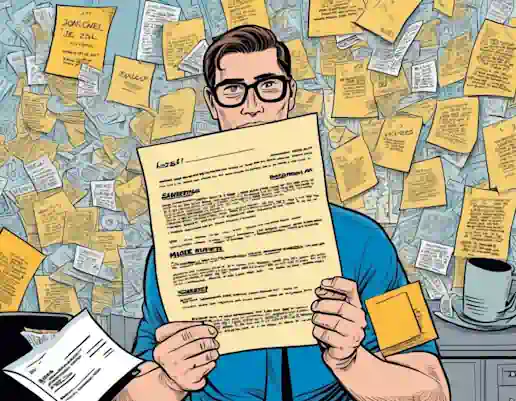
For the last few years, the main strategy in job applications was simple: "Optimize for the ATS". The strategy was to identify the nouns in a job description, such as: Python, Project Management, Stakeholder Engagement, etc., and ensure they appeared frequently in your resume. This is known as Decompositional Analysis. It is the process of breaking a complex text, the job description, into its constituent parts, keywords, and attempting to mirror them.
However, this method often fails.
The Trap of Decompositional Analysis
Common AI tools, such as ChatGPT, excels at decomposition. You can feed it a job description, and it will provide a list of keywords. But these tools lack context. They treat a CV like a shopping list rather than a professional narrative. When you use generic AI to stuff your CV with keywords, you create a document that is structurally hollow. It may pass a primitive ATS filter, but it will fail the human component with the recruiter.
The Rise of the AI-Detector
As candidates use AI to write cover letters and CVs, recruiters have responded with AI-driven detectors. These tools are trained to identify the "robotic" linguistic patterns that characterize generic AI output, and we all know what that looks like...
When your CV displays those patterns, you aren't just being ignored; you are being flagged. The very tool you used to improve your CV has become the reason you were disqualified. The keyword era has ended because the technology used to find keywords has become too smart to be fooled by them.
The Paradigm Shift: From Keywords to Gap Analysis
To improve the chances of getting an interview, you must move beyond the surface level. The breakthrough comes when you stop viewing the job description as a list of words and start viewing it as a set of underlying requirements and missing pieces.
This is the transition from Decompositional Analysis to deep Gap Analysis.
The Power of Semantic Analysis
Unlike standard AI tools, which look for exact word matches, Mova utilizes Semantic Analysis. This involves understanding the intent and context behind the text. For example, a job description might not explicitly mention "cross-functional leadership," but it might describe "collaborating with engineering, product, and marketing teams to drive roadmap delivery." A semantic engine recognizes that these are the same thing.
By focusing on meaning rather than the specific characters, you can much better align your profile with the job role.
Regressive Analysis: Finding the Unspoken
The most effective way to use AI in your job search is through Regressive Analysis. This is the process of looking at the stated requirements and "regressing" back to the fundamental needs of the business.
If a job description emphasizes "managing high-pressure deadlines and shifting priorities," the regressive requirement isn't just "time management" but the "resilience" and "operational agility". When you identify these requirements, you can better position your capabilities that go far beyond the keyword matching.
Connective Analysis: Bridging the Gap
The final piece of the puzzle is Connective Analysis. This is where you identify the specific gaps between your current profile and the target role.
The Mova gap analysis doesn't just tell you what you lack, it tells you how to bridge that gap. It identifies the connective tissue between your past achievements and the future needs of the company. Instead of saying, "I have experience in X," a gap-analysis-driven approach allows you to say, "My experience in X provides the exact structural foundation needed to solve your current challenge with Y."
The Human-Centric Mandate
Your ultimate goal of using AI in your job search shouldn't be on how to become more like a machine, but on how to use the machine to become a more human candidate.
The most successful CVs are Human-Centric. They avoid the predictable, often rhythmic, and definitely overly-polished patterns that trigger the recruiters' AI detectors. They use nuance, varied sentence structures, and specific evidence pieces.
You want the precision of a gap analysis to guide your strategy, but the final output must be a narrative that a human recruiter can connect with emotionally and professionally.
Actionable Strategies for the Modern Candidate

Pro-Tip: These strategies are most effective when applied consistently across both your CV and your LinkedIn "About" section to ensure a unified professional narrative.
If you want to climb out of the application black hole and actually improve your chances of landing an interview, try these five strategies immediately:
- Audit for "Robotic" Patterns: Take your current CV and run it through basic readability tests. If your sentences all follow the same "Verb + Task + Result" structure with similar lengths, you will likely be flagged. Vary your syntax.
- Perform Your Own Gap Analysis: Before applying, print the job description, highlight the explicit requirements in one colour and the implied requirements (the "regressive" needs) in a different colour. If your CV is not addressing the second colour, you are not ready to apply.
- Prioritize Context Over Keywords: Instead of adding the word "Leadership" five times, describe a specific instance where your leadership led to a measurable pivot in a project. Context is the antidote to the "keyword stuffing" trap.
- Use Semantic Mapping: When preparing for an interview or updating your LinkedIn, think in terms of Semantics. If you are a Project Manager, don't just list "Agile." List the ecosystem: "Scrum, Kanban, Sprint Planning, Backlog Grooming, and Velocity Tracking." This demonstrates depth of knowledge that a simple keyword search cannot replicate.
- Focus on the "Connective Tissue": In your cover letter, do not summarize your resume. Instead, use the Connective Analysis method: Identify a specific problem mentioned in the job description and explicitly map your specific past success to that problem.
Conclusion: The Verdict on AI CV Analysis
Does AI CV analysis actually improve your interview chances?
Yes, but only if you are using the AI as a tool to best position yourself.
If you simply use AI to perform keyword matching, you are part of a failing strategy that only increases your risk of detection and rejection. You are just noise that will never reach a human recruiter.
However, if you use an AI, such as Mova, to perform deep Gap Analysis, Semantic Matching, and Regressive Analysis, you stop being just another automated candidate and become the solution. By identifying the underlying requirements of a role and bridging the gaps in your profile with human-centric text, you move from the "black hole" to the top of the shortlist.
The future of the job search belongs to those who can leverage the precision of technology to highlight the irreplaceable value of their human experience.