Short answer
A career change at 40 does not mean starting over. With your 20+ years of experience in how work really gets done, that carries across industries far more than you may expect. The hard parts are usually self-doubt and job titles that may not translate, and both are manageable.
- Your experience travels further than your job title.
- Pay varies: some people see a pay rise, others match their old pay soon after.
- A 30-minute AI interview is a good first step.
- Doubt is normal, and it fades once you sit down for your job interview.

Is 40 too late for a career change?
No, and I'd go further: 40 is a good age to do it. You are still in the middle of your most productive years, with the energy to put in serious work coupled with a long record of problems solved.
What sometimes gets in the way is imposter syndrome: after years of being the person who knows the field inside and out, starting somewhere new can be uncomfortable. So keep in mind that the people hiring you know you won't be at your best in week one. They're hiring for what shows up after a couple of months on the job, whether that's skills the company didn't have or a fresh pair of eyes on old problems.
Can I be "too old"? The answer mostly depends on the role. If it is physically demanding and pays little, ask honestly whether it suits you. If it needs experience, people management and a contact network, you are well positioned, and the same goes for a career change at 45.
Do I have to start at the bottom or take a pay cut?
Not necessarily, though I won't pretend a midlife career change comes with a guarantee either way. Some people see a pay rise. Others enjoy working in a job or industry closer to their heart and, soon after, match or beat their old pay.
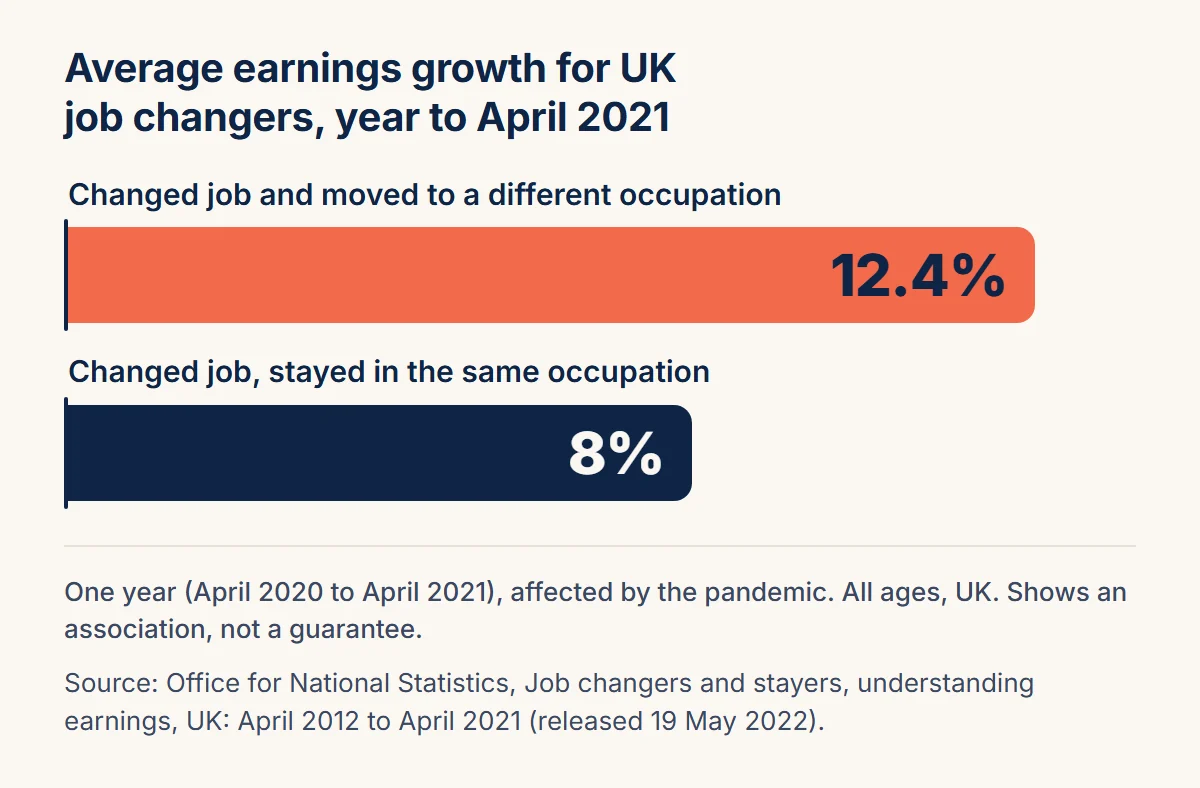
The evidence is mixed. In the UK, ONS data between April 2020 and April 2021 show that people who changed job and moved to a different occupation had average earnings growth of 12.4%, against 8% for those who changed job but stayed in the same occupation. It's data from a single year, which was affected by the pandemic, and it covers all ages, so your experience might be different.
For context, I have seen some of my friends move into different, emerging industries in their 30s and 40s, and most got a pay rise, but not all. I see this as a need from emerging industries, where fewer people have direct experience, companies may pay extra for soft skills that often translate.
What you might lack is knowledge of the new industry, but that only matters in the first couple of months. After that, your experience takes over.
How to change careers at 40: where do I start?
I see two types: those who crave a change but don't know what to aim for, and those who mostly know what they want.
If you are part of the first group and can afford it, a career coach can really help.
Career coaches have worked with plenty of people in your position, have seen the before and after on cases similar to you and are by far the best people to advise you on next steps. Many offer an affordable or even free initial consultation, giving you a chance to test the waters before committing to a plan.
On the other side, if you have a rough idea of what you want your next step to be, asking your AI of choice can get you surprising results in half an hour. Attach your CV, paste in this prompt and answer honestly:
I'm considering a career change. Please interview me, using my attached CV as background.
I like doing: [examples]
I dislike doing: [examples]
Industries I've wondered about: [industries]
Outside work I enjoy: [examples]
Strengths my CV does not show: [examples]
Ask me 5 to 10 questions and wait for my answer. Then summarise 3 to 5 role directions that suit me, with reasons, and what industries I should target. Consider my transferable skills.
One note: before you paste anything, remove what you wouldn't want your AI to see, such as names, contact details and confidential employer information.
Whatever comes back, take notice of how it makes you feel and whether any suggestion gives you a little spark. That's worth following.

How do I get past job titles and keyword filters?
Once you have a direction, the job search itself can be frustrating when changing careers at 40, because job boards and keyword filters match on titles, and your title might be super specific to your current company. Many businesses use internal titles that make sense inside the building and nowhere else. If you're coming from a big company, yours may be long and very specific. Here are four examples:
| Internal title (makes sense only inside one company) | Broader title for a smaller company | What it tells a new employer |
|---|---|---|
| Senior Principal Associate, Global Merchant Trust and Escalations (Tier 3) | Customer Operations Lead | You handled difficult customer problems and guided others through them |
| Staff Engineer II, Platform Reliability and Developer Experience | Engineering Team Lead | You keep complex systems running and can help other engineers do the same |
| Associate Director, Regional Commercial Partnerships and Enablement | Sales and Partnerships Manager | You built and grew business relationships and can do it in a smaller team |
| Programme Delivery Analyst III, Strategic Transformation Office | Project Manager | You planned and delivered complex projects with many people involved |
Illustrative examples.
A simple fix: when you apply to a smaller company, use a broader title that says what you did and what you can bring. And don't rely on job boards alone: your network often hears about roles before they are posted, so use a tool like LinkedIn for this.
To keep an eye on job boards, we built Mova. See Mova for career changers for how we support pivots like yours. Every day it scans the job market and matches roles to your experience and skills, using context, not just titles, and it only shows roles posted in the last 24 hours. For each match it builds an application strategy: how to position yourself, CV recommendations, an ATS (applicant tracking system) keyword check and a cover letter angle. There's no auto-apply, on purpose, because your best asset is your personality and experience.
How do I talk about my experience?
When you do land an interview, rely on your experience and the growth mindset you bring. A simple structure for your stories is: "I faced a problem with X, I changed Y, and the result was Z." Be upfront about past failures too, and what you learned from them. And remember that you lived through 15 years of enormous technology change, which says a lot about how adaptable you are, even if you've never thought of it that way.
What can I do tonight?
Tonight, run the 30-minute interview and see which directions surprise you. In my experience the doubt hits hardest when you start applying and hear nothing back. It takes a lot of applications to land an interview, despite what your CV may look like, so please don't read silence as a verdict on you. The first interview invite is where it turns, because you finally get to talk about what you've done and who you are.
If you'd like help with the job search and the applications themselves, Mova has a 7-day free trial, no card needed. Either way, you have more to offer than you realise. At 40 you get to choose where your heart is. You can do this.
Frequently asked questions
Is it too late for a career change at 40 or 45?
No. At 40 you are in the middle of your most productive years, with a long record of problems solved. The people hiring you know you won't be at your best in week one, and they are hiring for what shows up afterwards.
Will a career change at 40 in the UK mean a pay cut?
Not necessarily, though there is no guarantee either way. Some people see a pay rise, and others soon match or beat their old pay. UK ONS data between April 2020 and April 2021 show average earnings growth of 12.4% for job changers who moved occupation, against 8% for those who stayed in the same occupation. That is one year, affected by the pandemic, and it covers all ages.
What is the best career change at 40?
The one that uses the experience you already have and sits closer to what you enjoy. Try the 30-minute AI interview in this post and notice which suggestions give you a little spark.
Where do I start if I'm not sure what I want?
If you feel lost and can afford it, a career coach can really help. Otherwise, give an AI assistant your CV and the prompt in this post, answer honestly for half an hour, and remove names, contact details and confidential employer information first.